

By definition, a chemical fume hood is a ventilated enclosure that is designed to limit exposure to hazardous or toxic fumes, vapors, or dust, making it the cornerstone of laboratory ventilation safety.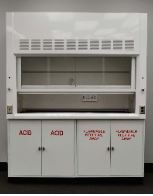
As the most critical piece of laboratory safety equipment, fume hoods protect employees by removing harmful vapors and chemicals through a carefully engineered fume hood airflow mechanism. The air they extract is then filtered by the building’s exhaust system before exiting the facility. That, right there, is the simple, two-sentence version of how a ducted fume hood works. But let’s dig a little deeper into how these devices function.
How Fume Hoods Protect Workers
As stated, the primary purpose of the fume hood is to contain gases, vapors, and fumes and exhaust them out of the area. When used properly, fume hoods are one of the most reliable laboratory engineering controls in a laboratory. They protect users by:
-
- Containing vapors and fumes generated within the hood and removing them from the laboratory through the exhaust system
- Providing a physical barrier via the sash, which is typically constructed of safety glass or shatter-resistant polycarbonate, to protect users from splashes, chemical reactions, or minor pressure events inside the hood.
How a Fume Hood Works: The 3-Step Airflow Process
1. Pulling Contaminated Air In Through the Sash
The chemical fume hood operation begins by pulling air from the surrounding room through the sash opening, creating a negative pressure zone inside the enclosure.
The air being pulled through the fume hood is measured in one of two ways:
- Volumetric Flow of Air: This is a measure of cubic feet per minute (CFM) which measures the total volume of air moving through the hood. A standard 6-foot fume hood typically operates between 250 and 600 CFM, depending on sash height and hood type, a range that must be balanced against the room’s makeup air supply. This means that air is filling a cubic foot of space, and then the velocity at which air flows out of that space is measured.This is important because having too much or too little air will affect the performance of the hood. Finding the proper balance is what leads to optimal fume hood performance and
efficiency.Because fume hoods move mass quantities of air, makeup air needs to be added to the room to maintain this proper balance.
Makeup air, which is replacement air supplied to the room via HVAC to compensate for what the hood exhausts, must be continuously replenished. Without adequate makeup air, the room develops negative pressure, reducing hood performance
If the room is small or if there are several fume hoods in the same room, an additional supply of air may be required. If the makeup air supply is not adequate or the makeup air is switched off, then the fume hoods may not be able to achieve the required face velocity, which can cause fumes to escape into the laboratory. OSHA and ANSI/ASHRAE 110 guidelines recommend a face velocity of 80 to 120 feet per minute (FPM) for most general chemistry applications. If makeup air is insufficient, velocity can drop below this threshold.
- Face Velocity: This is the speed of the air entering the front of the fume hood. The height of the sash plays a critical role in this measurement.
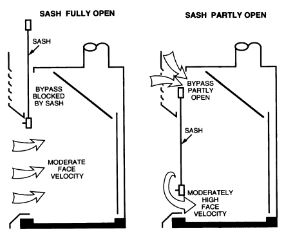 Think of face velocity as a garden hose that can’t quite reach the outer perimeter of the yard. Water will flow through a garden hose at a normal rate, but when you put your thumb on the end of the hose and create a partial blockade, the water exits with much more force.The same amount of water is still entering the hose, and the same amount of water is exiting the hose. But because of the blockade of your thumb, the exit velocity increases.
The same can be said for how air moves through a fume hood. The fume hood sash acts as an adjustable blockade that controls the linear rate of air moving through the hood opening, directly regulating face velocity. Most fume hood manufacturers and safety standards recommend operating the sash at or below the designated working height mark (typically 18 inches), which is where the hood has been tested and certified to perform.
2. Directing Vapors Toward the Exhaust Baffles
As the airflow works its way through the middle of the fume hood, the hood pushes the harmful gases 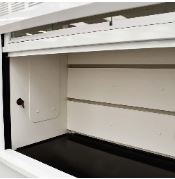 and fumes toward the slots and baffles. The slots and baffles are engineered to direct contaminated air toward the connected fume hood exhaust system, ensuring no dead zones form inside the chamber.
In many hoods, the slots and baffles are adjusted to allow for even airflow. When used properly, baffles eliminate dead spots or reverse air flows, which could result in vapors escaping the hood. If the baffles are closed or blocked by items inside the hood, the exhaust path will be blocked.
3. Exhausting Air Through Ductwork
An exhaust fan at the top of the building pulls air through connected ductwork and expels it safely outside. A ductless fume hood, by contrast, filters and recirculates the air back into the room. Ductless fume hoods are easier to install since no ductwork is required, but they are only appropriate for a limited range of chemicals. They cannot safely handle highly toxic, carcinogenic, or radioactive materials, which require a ducted connection to an outside exhaust.
Different Types of Fume Hoods for Different Uses
Constant Air Volume (CAV) vs. Variable Air Volume (VAV) Hoods
- Constant air volume hoods: A constant air volume (CAV) fume hood exhausts the same amount of air all the time, regardless of sash position. As the sash is lowered and raised, the face velocity increases or decreases proportionally. Therefore, higher face velocities can be obtained by lowering the sash.
- Variable air volume hoods: A variable air volume (VAV) fume hood exhausts air flow based on sash height to maintain a set face velocity. As the sash is lowered and raised, the face velocity stays the same while less total air volume is exhausted.
VAV fume hoods are equipped with a monitor that indicates whether the hood is in “standard operation” or “standby operation” mode. The monitor also has an “emergency purge” button, which increases airflow through the hood and can be used to quickly remove contaminants from the lab. VAV fume hoods are equipped with flow sensors that activate an audible alarm when malfunctions occur.
Specialty Fume Hoods for Specific Chemicals
There are certain fume hoods for special uses, and some even cater to specific chemicals. It is always best to consult the manufacturer’s recommendations for proper use and safety standards to ensure that your hood is efficient and effective.
Fume Hood Safety: Best Practices for Proper Operation
Even a properly functioning fume hood can fail to protect users if operated incorrectly. The most common mistakes include storing large equipment or chemical bottles near the sash opening (which disrupts airflow) and working with the sash raised above the certified working height. These habits undermine the hood’s containment ability regardless of its mechanical condition.
National Laboratory Sales is the exclusive distributor of Fisher American fume hoods and also has a large selection of hoods from Labconco, Fisher Hamilton, Kewaunee, Hamilton Scientific, and many others. Search our impressive inventory to find a fume hood that works for you.