

TL;DR
– Most labs use 4, 6, or 8 ft fume hoods. NLS carries 3 to 14 ft, and 6 ft is the size it stocks most.
– The width in the name is the outside measurement. Inside, you lose about 10 inches.
– Your biggest piece of equipment decides the size. It has to fit at least 6 inches behind the sash, with room to work around it.
– A benchtop hood on base cabinets stands about 7.5 feet tall before ductwork. Check your ceiling.
What are the standard fume hood sizes?
Benchtop fume hoods come in 3, 4, 5, 6, 8, 10, and 12 ft widths. The 4, 6, and 8 ft sizes are the ones you’ll see most.
| Nominal size | Exterior (W × D × H) | Height with base cabinets | Interior work area (W × D × H) |
|---|---|---|---|
| 4 ft | 48″ × 32″ × 54.5″ | 89.5″ | 38.5″ × 22.5″ × 46″ |
| 6 ft | 72″ × 32″ × 54.5″ | 89.5″ | 62.5″ × 22.5″ × 46″ |
| 8 ft | 96″ × 32″ × 54.5″ | 89.5″ | 86″ × 22.5″ × 46″ |
Across these three models, only the width changes. Depth and height stay the same, so once you know your hood’s width, you can plan for the rest of the footprint.
How wide should your fume hood be?
Width comes down to two things: how many people need hood space, and how big your equipment is.
How much hood space does each person need?
The National Research Council’s Prudent Practices in the Laboratory recommends at least 2.5 linear feet of hood space per person in labs where people spend most of the day on chemical work.
So a lab with four chemists needs about 10 feet of hood space. One 4 ft hood and one 6 ft hood would cover it.
Plan on one person working at a hood at a time. Two people side by side means more arm movement at the sash, and that movement disturbs airflow. If two people really need to share, an 8 ft hood with horizontal sliding sash panels gives each of them their own opening.
How do you fit equipment inside the hood?
Measure your largest piece of equipment, then compare it to the interior width, not the size in the name.
Say you’ve got a 60-inch apparatus. A 6 ft hood is only 62.5 inches wide inside, which leaves about an inch on each side. That’s too tight to reach around it or keep air moving. An 8 ft hood gives you 86 inches, so you’d have about 13 inches on each side.
Big equipment also blocks airflow along the work surface. Set it on blocks or lab jacks so it sits 1 to 2 inches up and air can pass underneath.
While designing the layout of your laboratory, you will need to plan for the placement of the fume hood. A successful laboratory layout will promote the use of laboratory space while ensuring safe working conditions for laboratory personnel.
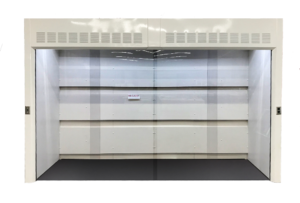
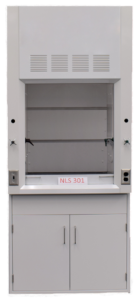
The fume hood size that you need will depend on factors such as the equipment you plan to use inside the hood, the type of work you will be performing, and how large your physical space is.
The size of the room will determine whether you’ll need a 3-foot or a 12-foot hood, but the equipment you plan on using within the hood will determine whether a 5-foot or a 6-foot hood is necessary.
Also, if your lab will be occupied by multiple people, a facility designed for intensive chemical use should have at least 2.5 linear feet of hood space per person.
How deep does a fume hood need to be?
A standard benchtop fume hood gives you about 22.5 inches of interior depth. All three hoods in the table above share that number.
You can’t use all of it, though. Everything in the hood should sit at least 6 inches behind the plane of the sash. That leaves roughly 16.5 inches of front-to-back space for equipment.
If your equipment is deeper than that, ask NLS about deeper models or a walk-in hood.
How tall is a fume hood, and will it fit under your ceiling?
The hood alone is 54.5 inches tall. Put it on base cabinets and it’s 89.5 inches, close to 7.5 feet.
That number doesn’t include the exhaust duct connection on top. Before you order, measure floor to ceiling and look for anything hanging over the spot, like soffits, light fixtures, sprinkler heads, or existing ductwork.
Inside, you get 46 inches of height. That’s plenty for most work, but tall glassware setups can run out of room.
If you’re still planning the room itself, our fume hood placement guidelines cover where a hood should and shouldn’t go.
Not sure what size you need?
Send your equipment dimensions, ceiling height, and how many people will use the hood. We’ll tell you which hoods fit.
Call (815) 670-6400, send us a message, or browse fume hoods by size.
FAQs
What is the most common fume hood size?
6 ft. It’s the size National Laboratory Sales stocks most, and it fits most standard lab equipment with room to work. A 4 ft hood is the usual pick for small labs or light-duty work.
How much ceiling height do I need for a fume hood?
A benchtop hood on base cabinets is about 89.5 inches tall. Add room for the exhaust duct connection on top, and check for lights, sprinklers, and soffits over the spot.
Can two people share one fume hood?
Plan for one person per hood at a time. If two people need to work together, choose an 8 ft hood with horizontal sliding sash panels so each person has their own opening.
How much smaller is the inside of a fume hood than the outside?
About 9.5 to 10 inches narrower. A 6 ft hood is 72 inches wide outside and 62.5 inches inside.