
When it comes to laboratory safety, knowing whether to use a chemical fume hood or a biological safety cabinet (BSC) is one of the most critical decisions in laboratory safety planning. These pieces of equipment may seem similar at a glance, but they serve distinct purposes and are suited for different types of work. We’ll break down the key differences between a fume hood and a biosafety cabinet — covering airflow design, filtration, hazard type compatibility, and regulatory classifications — so you can make the right choice for your specific lab application.
What are Fume Hoods Designed For
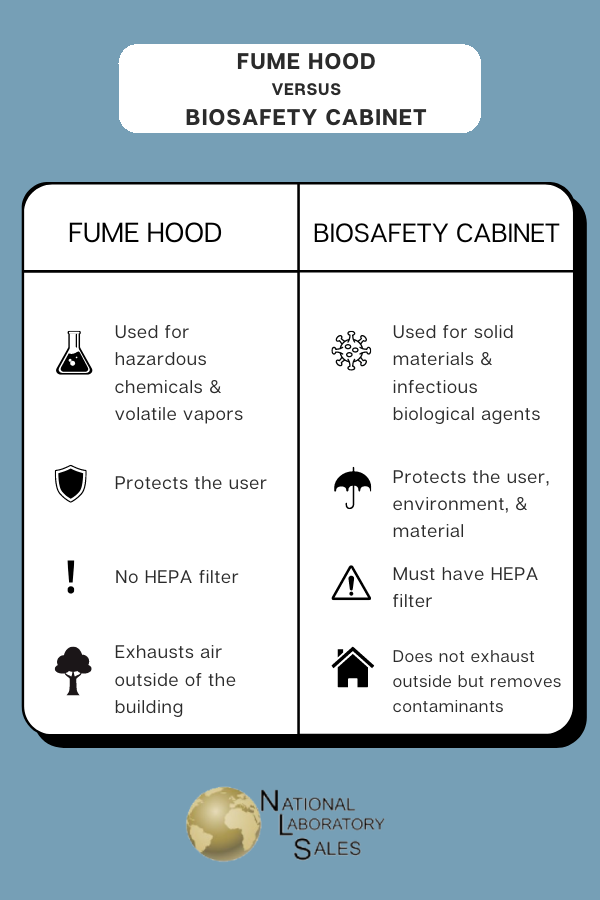
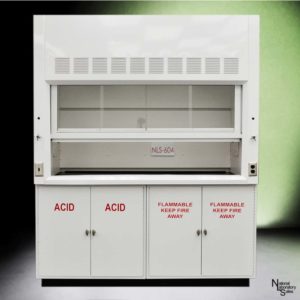
Fume hoods protect users from hazardous chemicals, volatile organic compounds (VOCs), and toxic vapors by continuously drawing contaminated air away from the breathing zone. The ventilated enclosures maintain a minimum face velocity — typically 80–120 linear feet per minute (LFM) — drawing air away from the laboratory worker and preventing vapor inhalation. In a ducted fume hood, this evacuation continues through ductwork to an external exhaust point; ductless fume hood models recirculate air through internal carbon filters instead.
What Hazards Biosafety Cabinets are Designed For
Biosafety cabinets are engineered to protect the user, the environment, and the biological material itself, making them the standard choice for working with infectious agents at biosafety level 2 (BSL-2) and above. The defining difference between a fume hood vs BSC is the HEPA filter: biosafety cabinets use high-efficiency particulate air (HEPA) filtration capable of capturing 99.97% of particles 0.3 microns or larger, including all known biological agents.
In a Class II Type A2 biosafety cabinet, the most common BSC configuration, the HEPA filter traps all known infectious agents and recirculates microbe-free air back into the laboratory environment. HEPA filters are highly effective against particulates but cannot capture chemical vapors or gases — a critical limitation when working with volatile solvents or formaldehyde, which require a ducted fume hood instead.
Because biosafety cabinets recirculate filtered air within the workspace, gas vapors are dispersed back into the laboratory, which is a potentially dangerous outcome when following CDC/NIH biosafety guidelines that prohibit mixing chemical and biological hazards in a single BSC workflow.
Related: Can a Fume Hood be Used as a BioSafety Cabinet?
In summary, fume hoods take air and contaminants away from the user. In doing so, fume hoods dilute and exhaust gases before they can accumulate to hazardous concentrations, complementing, but never replacing, proper laboratory personal protective equipment (PPE) such as gloves, goggles, and lab coats.
Biosafety cabinets, on the other hand, filter particles from the laboratory air and remove airborne contaminants within the hood.
Shop Fume Hoods at National Laboratory Sales
National Laboratory Sales has the right fume hood for your laboratory. Along with a full line of new and used laboratory casework, we offer a one-stop experience for high-quality products and quick shipment. Contact National Laboratory Sales today!
Fume Hood vs. Biosafety Cabinet: Side-by-Side Comparison