

Keeping your lab safe is no small task, especially when your team works daily with volatile solvents, corrosive acids, or toxic chemical vapors. A fume hood is your primary line of defense, but a hood that isn’t regularly tested and certified may be failing silently, putting workers at risk without any visible warning signs.
Chemical fume hoods are crucial to maintaining a safe work environment. They should be tested and certified to ensure that they’re operating at optimal airflow levels for containing hazardous chemical vapors and gases.
How Often Should Fume Hoods Be Tested?
According to fume hood compliance OSHA standards, every chemical fume hood in an active laboratory must undergo a laboratory fume hood annual inspection to remain in safe operating condition.
Additionally, there are three test types: As Manufactured (AM), As Installed (AI), and As Used (AU).
- AM is done once the hood is built and is generally done in a testing lab where environmental factors are removed as much as possible.
- AI testing is done once the hood is installed in the lab but before anything is placed inside. This can reveal issues related to how the hood was installed, room operation/location, and other factors affecting the room environment.
- Finally, AU testing is done in the lab with materials inside the hood. This test takes into account both the room environment and users and can determine if there is an issue with how it is being operated by comparing the test results to the AI results.
The AU test should be conducted annually.
ASHRAE 110: The Gold Standard for Fume Hood Performance Testing
 ASHRAE, the American Society of Heating, Refrigerating and Air-Conditioning Engineers, is the standards body whose testing protocols define what ‘safe’ means for laboratory ventilation equipment in the United States. For fume hoods specifically, ASHRAE 110 is the governing performance standard referenced by OSHA, lab accreditation bodies like A2LA, and institutional EHS departments.
ASHRAE publishes standards for testing regarding the design and maintenance of indoor environments. The standards define minimum values for the accepted performance of a variety of ventilation-related products.
ASHRAE 110 is a quantitative test procedure for determining the operating capabilities of a fume hood. The test measures how the hood contains and exhausts fumes.
ASHRAE 110 has been the standard for testing fume hood containment since 1985. In April 2016, ASHRAE 110 was updated to create a more accurate test and a safer work environment.
The 2016 revision introduced digital data logging as a requirement, replacing manual pen-and-paper recording. This change significantly reduces transcription errors and makes test results directly comparable year over year. This is critical for identifying gradual airflow degradation before it becomes a safety hazard. Labs that still hold certifications issued under the pre-2016 standard should confirm their testing provider is using the updated protocol.
The ASHRAE 110 fume hood test procedure evaluates three critical performance areas: fume hood face velocity requirements, smoke visualization, and fume hood containment testing via tracer gas.
Face Velocity Measurement: What It Is and Acceptable Ranges
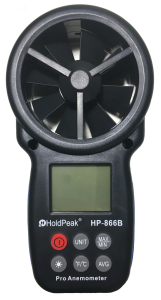
The face velocity test measures the speed of the airflow within a fume hood. An average reading is calculated from measurements taken from multiple points within the fume hood. It also includes the measurement of cross-drafts around the hood and the calibration of airflow monitors.
The actual measurement is done with a digital electronic anemometer. This device measures the airflow in feet per minute (fpm). To meet fume hood face velocity requirements, the hood must measure between 95–130 fpm, the accepted range for safe chemical fume hood airflow certification.
Maintaining proper face velocity not only ensures operator safety but also complies with industry best practices for laboratory safety
Smoke Visualization Testing: How Containment Is Verified Visually
The smoke visualization test fume hood procedure uses standardized smoke-generating substances to physically verify fume hood containment testing at multiple sash heights.
The smoke visualization test has procedures for both small volumes and large volumes of smoke to clearly see how the air moves and is contained within the hood. In addition to airflow patterns, it shows how contaminants could escape and reach the operator at various sash heights.
A hood passes the smoke visualization test when all generated smoke is visibly drawn into the hood and exhausted without escaping the sash opening. A failure is indicated by smoke rolling out of the hood face toward the operator — even a small escape is considered a containment breach requiring investigation before the hood is returned to service.
Tracer Gas Containment Testing: Quantifying Chemical Exposure Risk
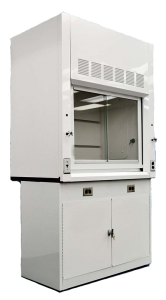 The tracer gas test determines exposure levels based on how many contaminated particles can escape the hood and reach the operator’s breathing zone.
In the tracer gas fume hood test, sulfur hexafluoride (SF6) — a dense, inert gas — is injected into the hood to simulate the behavior of hazardous chemical vapors escaping into the operator’s breathing zone.
Of all three ASHRAE 110 methods, the tracer gas fume hood test with SF6 provides the most quantifiable measure of whether a hood achieves full fume hood containment testing standards.
Understanding Your Fume Hood Certification Sticker
Once a hood passes all three ASHRAE 110 evaluations, you receive a fume hood certification sticker displaying the inspection date, measured face velocity, and the technician’s certification. If your hood does not have a certification sticker or the last date of inspection on the sticker was more than a year ago, you need to get your fume hood tested.
Fume Hood Testing Documentation and Lab Accreditation
Documentation of each fume hood certification process not only meets lab accreditation requirements but also allows for effective troubleshooting if future airflow issues arise. By keeping a clear record of test results and safety assessments, labs can streamline the recertification process and maintain a secure environment.
To stay on track with your fume hood recertification schedule and maintain OSHA compliance, contact a certified local testing service. Most labs should book their laboratory fume hood annual inspection at least 30 days before their certification expires.
Frequently Asked Questions About Fume Hood Testing
Annually, per OSHA standards.
ASHRAE 110-2016 is the current U.S. standard.
Sulfur hexafluoride (SF6), at a maximum allowable concentration of 0.05 ppm at the operator’s breathing zone.
It should be removed from service until the cause is diagnosed and corrected.