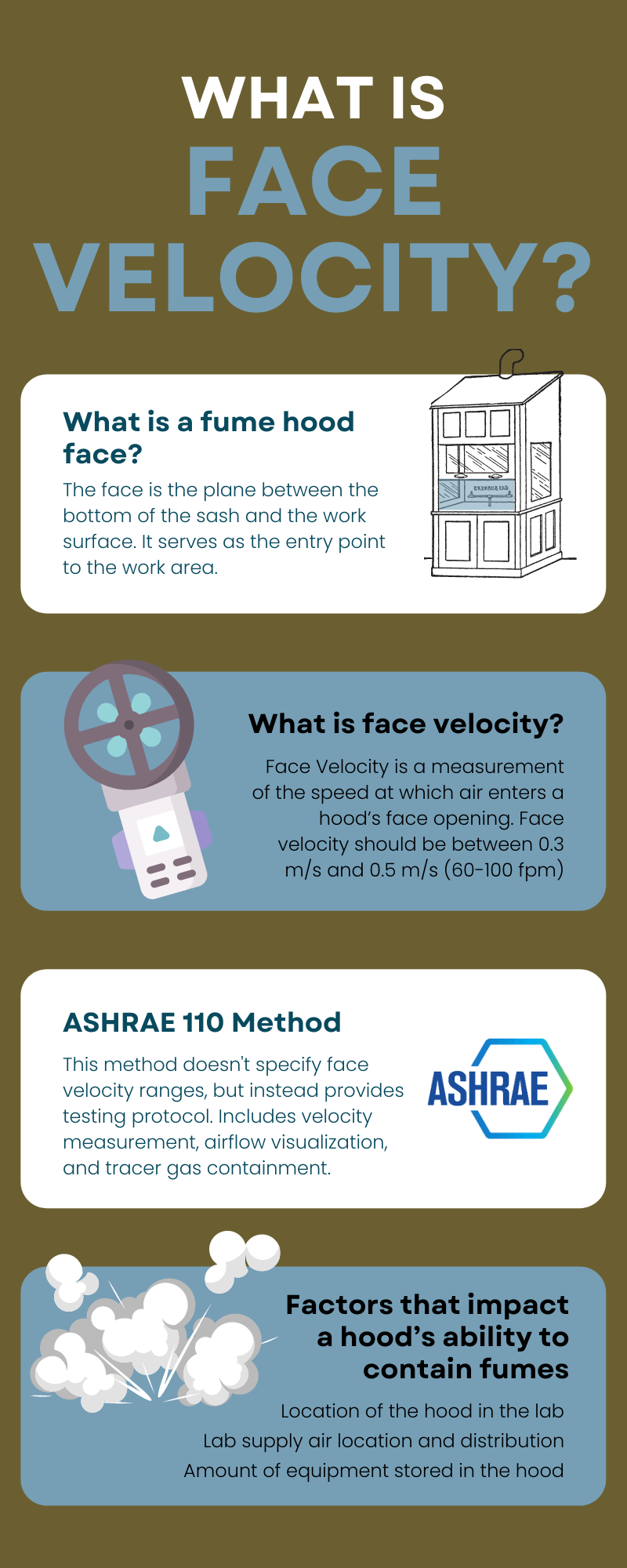

The speed at which air is drawn into a fume hood (e.g. its face velocity) is of great importance for the safe and effective operation of a fume hood. A speed that is too high or too low can compromise the performance of the fume hood, leaving those near the hood in danger. So why does this airspeed matter? What is so significant about the face velocity measurement of a fume hood?
Quick definition: Face velocity is the speed at which air moves through the open face of a fume hood, measured in feet per minute (fpm) or meters per second (m/s). Recommended ranges generally fall between 60–100 fpm (0.3–0.5 m/s), though exact requirements vary by regulation and lab use.
 Understanding the Fume Hood “Face”
Before measuring face velocity, it helps to understand fume hood anatomy — specifically the ‘face,’ the sash, and the work surface — since face velocity is defined in relation to these parts. The face is the imaginary plane between the bottom of the sash and the work surface. This is the opening through which air is pulled from the lab into the hood. It serves as the entry point for hands to enter the work area. Across this imaginary plane is where face velocity is measured using an appropriate monitor.
Recommended Face Velocity Range and Units
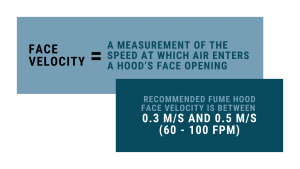 Face velocity, in simple terms: it’s a measurement of the speed at which air enters a hood’s face opening, expressed in feet per minute (fpm) or meters per second (m/s). It is generally recommended that a fume hood’s face velocity is between 0.3 m/s (60 fpm) and 0.5 m/s (100 fpm); however, it is best to check with local safety regulations because variations exist by state and use.
Several organizations have adopted fume hood safety standards as it relates to face velocity. These standards measure the ability of a fume hood to contain fumes and are based on the speed at which air enters a fume hood’s face. If face velocities are too high, turbulent eddies can form at the sash opening and pull contaminants back out into the worker’s breathing zone — the opposite of the hood’s intended containment effect. If face velocities are too low, the hood will not adequately exhaust dangerous fumes, vapors, gases, or dust from the room.
Using Face Velocity for Fume Hood Testing
 Although face velocity has been accepted as an adequate measure of a fume hood’s performance, it is not the be-all and end-all for fume hood performance standards. Many organizations (OSHA, NFPA, ANSI, SEFA, NIOSH, etc.) use face velocity as the only performance standard for fume hood testing, but by no means, this does not guarantee that the fume hood’s performance is optimal when it meets face velocity standards.
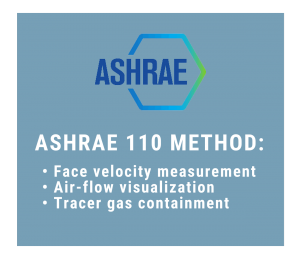
ASHRAE, the American Society of Heating, Refrigerating, and Air-Conditioning Engineers, created the ASHRAE 110-2016 Method of Testing Performance of Laboratory Fume Hoods. This process does not specify ranges for face velocities, but instead provides a thorough protocol for hood performance testing. The three-part test includes:
• Measurements of face velocity
• Airflow visualization with digital collection
• Tracer gas containment
This process goes beyond strictly measuring face velocity, forming the basis of comprehensive fume hood certification testing that also verifies the hood’s ability to contain and exhaust fumes.
Air-Flow Visualization
To measure airflow visualization, a smoke stream is created at various points in the fume hood work area. Then, visually, one can see and understand the airflow currents that exist inside the fume hood. Although airflow is observed through sight, data is collected digitally for more accurate results.
Tracer Gas Containment
The tracer gas containment test involves the release of gas inside the hood while a gas monitoring device is placed in the estimated breathing zone of a worker positioned near the fume hood. The device measures the presence of the tracer gas outside of the fume hood.
Why Face Velocity Alone Doesn’t Guarantee Containment
 Since face velocity is the only test required by most regulatory organizations, technicians typically calculate the average face velocity across several points on the sash opening, and that average is often the only test a fume hood ever receives. Even though other, more costly tests can provide a better measurement of a fume hood’s effectiveness and its ability to contain hazardous substances.
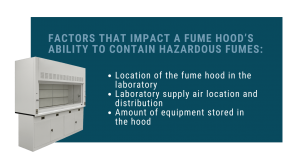
Additionally, there are factors unique to each setting that impact a hood’s ability to contain hazardous fumes. These factors include:
- Location of the fume hood in the laboratory
- Laboratory supply air location and distribution
- Amount of equipment stored in the hood
Although these factors may not affect the fume hood’s face velocity, they do impact the fume hood’s ability to contain hazardous substances. Many fume hoods routinely meet face velocity requirements but are not able to pass airflow and tracer gas tests.
Key Takeaways
Even if a fume hood’s face velocity is within safety recommendations by a local regulatory agency, it may not serve as a guarantee of complete containment. As with many situations, ensuring total safety is more complicated than a single test and requires addressing multiple issues. It’s worth understanding OSHA fume hood face velocity requirements before you purchase your next fume hood, but remember that face velocity alone isn’t the only test you need to confirm your fume hood is providing a safe work environment.